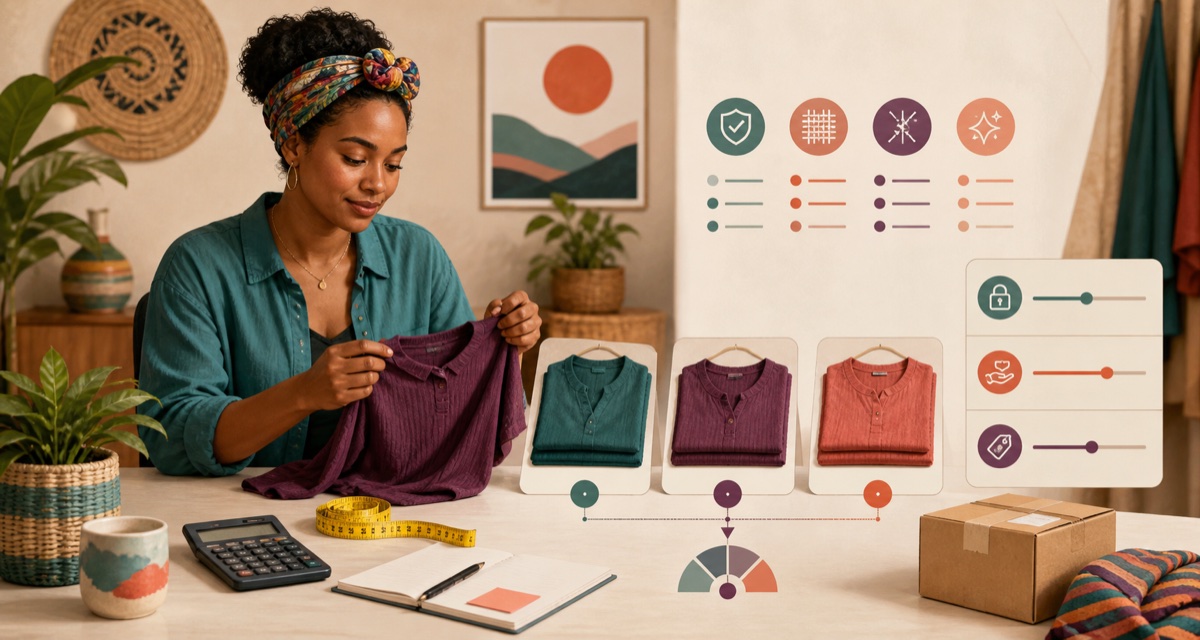
To price second-hand clothes, start with three to seven genuinely comparable South African listings, use their median as your market anchor, adjust for the condition of your actual item, and keep a private minimum. If you expect offers, calculate the buffer instead of adding a random amount.
Do not begin with “I paid R1,200, so I should get R600.” The original receipt tells you what the item cost then. It does not tell you what a buyer will pay now.
The short answer: calculate three prices
You need three different numbers:
| Number | What it answers | Keep it public? |
|---|---|---|
| Target sale price | What do current, qualified comparables support? | It can be, if your price is firm |
| Walk-away floor | What is the lowest amount you are actually willing to accept? | No |
| Listing price | What should the public price be if you allow room for offers? | Yes |
The target is about the market. The floor is about your own decision. The listing price is about your negotiation plan. Mixing them can turn a market-supported R350 target into an unsupported R700 listing.
A practical second-hand clothing pricing formula
Use this method as a starting point, not as a promise that an item will sell.
1. Find three to seven qualified comparables
Search for items that match as many of these details as possible:
- product type and model;
- brand and product line;
- adult or children’s sizing;
- condition;
- material and cut;
- included extras, such as a belt, box or proof of purchase;
- South African buyer market; and
- recent listing or sold date.
Prefer credible recent sold evidence where it is available. A current asking price only proves what another seller wants, not what a buyer accepted. On some marketplaces, a “sold” label may still show the old listing price rather than the final offer, so treat it as evidence with limits.
Exclude obvious typos, counterfeit or authenticity uncertainty, different product categories and collector collaborations unless yours is genuinely comparable. If you are pricing a standard hoodie, a limited collaboration is not a useful anchor just because the same logo appears on both.
2. Use the median, not the highest price
Sort the comparable prices from low to high and choose the middle value. If you have an even number, average the two middle values.
Comparable anchor (C) = median of three to seven qualified comparable prices
The median gives one unrealistic high or low price less power over your answer. Do not select only the most expensive listings because you like their answer.
3. Adjust in rand for the actual item
Now compare your piece with the pieces behind the median:
Target sale price (T) = C + supported additions − remedy and risk deductions
A supported addition needs evidence. Tags, an original belt or strong proof of authenticity may support a higher price if otherwise similar items with those details command more. They do not automatically add a fixed percentage.
A deduction should reflect something the buyer must accept or remedy: a missing button, heel wear, a stain, altered hem, damaged box or uncertain repair. Estimate the direct remedy cost where possible, then account for the remaining inconvenience or risk. Disclose the issue in the description and photographs; a discount does not make a hidden defect acceptable.
4. Calculate your private floor
For a reseller, first total the rand amounts that do not change with the sale price:
Base floor (K) = stock cost + preparation + packaging + fixed seller-paid costs + minimum acceptable profit
If the selling channel deducts a percentage of the accepted item price, calculate the actual floor as:
Walk-away floor (F) = K ÷ (1 − seller fee rate)
With no percentage deduction, the rate is zero and the floor equals K. If K is R185 and a channel deducts 10% from the seller, the floor is R185 ÷ 0.90 = R205.56, so rounding up to R206 protects the stated minimum. Simply adding 10% to R185 would leave the seller short after the deduction.
Check the current fee schedule on the platform you use. Buyer-side delivery and protection charges are not the same as seller deductions, but they still affect whether the buyer’s total feels worthwhile.
If you are clearing your own cupboard, the old purchase price is already spent. Your floor is simply the minimum at which selling is better, for you, than keeping, donating or swapping the item.
If your floor is higher than the market-supported target, the formula has found a real problem. Lower the required profit, reduce your costs, create a sensible bundle, wait for better evidence or do not list. Calling your floor “market value” will not make buyers agree.
5. Add an offer buffer only if you intend to negotiate
Choose the largest discount you are prepared to give before you publish. Then use:
Listing price (L) = T ÷ (1 − planned negotiation rate)
If your target is R340 and you want room for a maximum 10% offer:
R340 ÷ 0.90 = R377.78, which you could round to R380. A 10% reduction from R380 is R342, close to the R340 target.
If your price is firm, the planned negotiation rate is zero and your listing price is the target price. Do not create a fake “original price” or inflate the listing purely to display a dramatic markdown.
What matters most when pricing preloved clothes?
Comparable quality matters more than comparable quantity
Twenty loosely related listings can mislead you more than three close matches. An adult rain jacket, a children’s fleece and a collector collaboration are not one hoodie market.
Use sold evidence as a stronger signal than active asks, but inspect it. Check dates, descriptions, sizes, photographs and whether “sold” means a completed platform transaction or only that the seller changed the status.
Condition must be specific
“Good condition” is not enough on its own. State what a buyer would see:
- New with tags: unworn, original tags still attached;
- Like new: worn or washed, but no visible wear you can identify;
- Good: light wear, fully usable, with every material issue disclosed; or
- Fair: obvious wear or repair needs, shown clearly and priced accordingly.
Use the marketplace’s actual condition labels when you list. Do not call an item new because it was worn only once.
Brand is only one part of demand
The exact product line, cut, material, size, colour and current buyer interest can matter as much as the name on the label. A brand’s original retail price is also a weak anchor when the same item is now discounted, widely available or out of fashion.
For high-value branded pieces, include clear photographs of labels, serial or style details, receipts and original packaging where available. If you cannot support an authenticity claim, do not price or describe the item as guaranteed authentic.
The buyer sees an all-in price
The seller thinks about the item price. The buyer may see:
Buyer total = accepted item price + buyer-side fees + delivery
That matters most for low-priced basics. A R70 top can feel expensive once a separate delivery charge is added. Where the marketplace treats a bundle as one order or parcel, a truthful two- or three-item bundle may create better value because the buyer spreads delivery over more clothing.
Do not move a protected marketplace transaction off-platform to avoid checkout costs. Check the marketplace’s current rules and use its legitimate bundle or offer tools.
Worked rand examples
Example 1: pricing a branded sweatshirt with public comparable evidence
On 26 August 2026, three adult Nike sweatshirt or hooded-outerwear listings marked “Good” and publicly marked sold on Vakoop displayed R250, R339 and R520. All three records had been marked sold manually, so they do not prove that checkout happened on Vakoop or that the displayed amount was the final transaction price. They were also not the same model. This is a method demonstration, not a Nike price guide.
The median is R339. Suppose your sweatshirt most closely resembles the middle item, has no undisclosed flaws and has no evidence-based reason for an addition or deduction:
- comparable anchor: R339;
- rounded target: R340;
- maximum planned offer: 10%;
- calculated listing price: R340 ÷ 0.90 = R377.78;
- public price: R380;
- acceptable 10% offer: R342.
Before using that result, look harder at why the R250 and R520 pieces differ. A closer model match could move the target.
Example 2: a reseller’s dress with a repair
Assume five close dress comparables have a median of R260. Your dress needs a R40 zip repair and carries about R20 of additional inconvenience or repair risk for the buyer.
Target = R260 − R40 − R20 = R200.
Your own costs are:
- stock: R80;
- cleaning: R15;
- packaging: R10;
- seller-paid transaction cost on the chosen channel: R0 in this example; and
- minimum acceptable profit: R80.
Floor = R80 + R15 + R10 + R0 + R80 = R185.
The R200 target clears the floor. If you do not want offers, list at R200. If your minimum profit pushed the floor to R240, the market evidence would no longer support your economics; hiding the repair or inventing a higher retail price would not fix that.
Example 3: when the old receipt gives the wrong answer
You paid R1,200 for a jacket, but similar current pieces are listed or marked sold at R350, R400 and R450. Their median is R400. If yours is genuinely similar, R400 is a more defensible target than “half of what I paid.”
If R400 feels too low, keeping the jacket is a valid choice. The buyer is not responsible for refunding your original spending decision.
When should you reduce the price?
Do not drop the price every time a listing has a quiet day. First diagnose the signal:
| What you observe | Test before cutting the price |
|---|---|
| Very few relevant views | Improve the first photo, title, category, brand, size and measurements |
| Views but no saves or questions | Recheck comparables, condition, style information and buyer all-in cost |
| Saves and questions but no offer | Clarify fit, flaws, delivery and whether the price is firm |
| Repeated offers near one number | Recheck whether that number is supported by better comparables |
| Offers below your floor | Decline or counter; do not negotiate against yourself |
Vakoop’s editorial test is to change one major variable at a time and record the date. If you replace the cover photo, rewrite the title and cut 20% together, you will not know which change helped.
When you do discount, make it real. South Africa’s Consumer Protection Act prohibits false or misleading material claims by suppliers, including false claims that a price advantage exists or that used goods are new. The precise application depends on whether someone is acting in the ordinary course of business and on the facts, so regular sellers should obtain advice for their situation. Accurate condition and price claims are good practice for every seller regardless.
Should you bundle low-priced clothes?
Bundle items when the same buyer would reasonably want them together: the same children’s size, work shirts in one size, or three basic tops. Do not use a bundle to hide one damaged item.
Calculate it from the floor up. If three tops have individual target prices of R100 each and individual floors of R60, their totals are R300 and R180. A R260 bundle gives the buyer R40 of item-price value while remaining above the combined floor. Whether that is sensible depends on packaging, delivery limits and your aim to clear stock.
Show every item, size and flaw separately. State whether the price is for the whole bundle.
Frequently asked questions
What percentage of retail should I charge for used clothes?
There is no reliable percentage that works across every brand, condition and item. Use the original retail price as a reasonableness check, then prioritise recent qualified comparables. A current sale price is more relevant than an old recommended retail price.
How do I price clothes if I cannot find the exact item?
Widen the search one factor at a time: exact model, then the same product line, then the same brand and item type, then a similar-quality brand. Use a range and start near its middle. The weaker the match, the less confident the estimate should be.
Should new-with-tags clothing be close to retail price?
Not automatically. Tags improve the condition evidence, but buyers can compare your price with the retailer’s current price, returns policy, stock availability and checkout total. Use new-with-tags comparables rather than applying a universal percentage.
How much room should I leave for offers?
Only as much as you genuinely plan to accept. If the maximum is 10%, divide the target by 0.90; do not simply add 10%, because those calculations produce different results. Use zero if your price is firm.
Should delivery be included in my clothing price?
Follow the marketplace’s current delivery setup. If delivery is charged separately, do not pretend it is included. Still inspect the buyer’s likely total, especially for low-value items and bundles.
How should I price vintage or designer clothing?
Use exact item, era, material, condition and authenticity evidence. Ordinary brand-level comparables are too broad. For a high-value item, consider qualified authentication or specialist valuation before making claims.
Can an AI tool price my clothes for me?
An AI suggestion can create a starting number, but it may misread the model, condition, authenticity or local demand. Check the evidence it exposes and keep control of the final price. On Vakoop, Genio’s suggested price is a draft for the seller to approve, not a guaranteed valuation.
Is it better to sell items separately or as a bundle?
List distinctive or higher-value pieces separately. Bundle lower-priced items that share a size, use or buyer. Compare the bundle price with the combined floor and make every included item clear.
Price the evidence, then decide what the item is worth to you
The cleanest pricing process is not “retail minus a percentage.” It is:
- qualify three to seven recent comparables;
- use the median;
- adjust for visible, item-specific differences;
- calculate your private floor;
- add a planned offer buffer only when needed; and
- recheck the buyer’s all-in cost.